
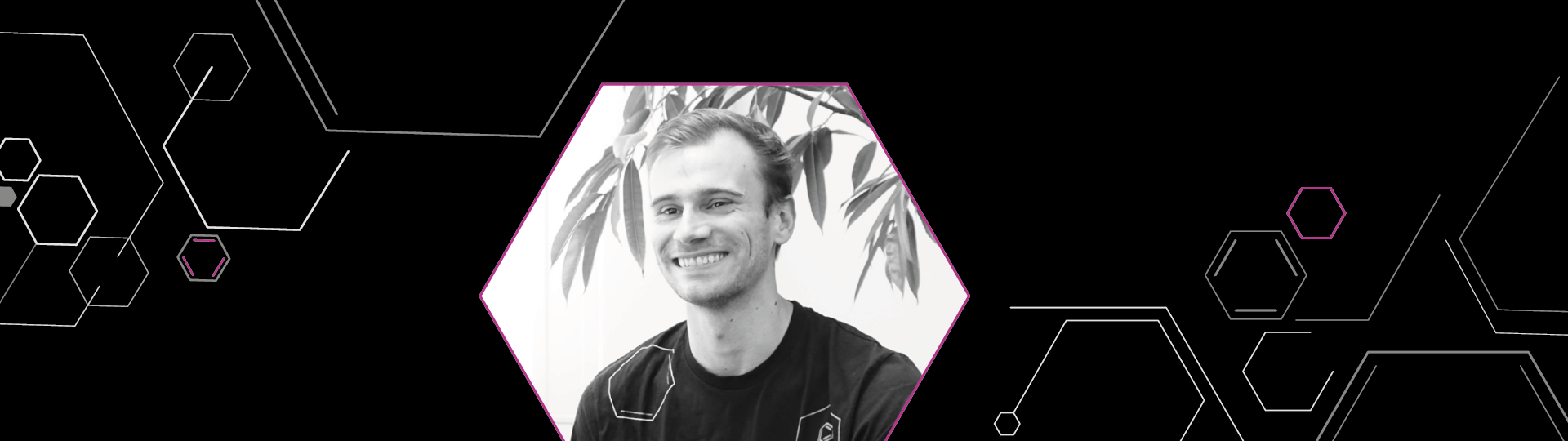
An interview with
Markus Weber | Application Specialist
“Chemistry is necessarily an experimental science: its conclusions are drawn from data, and its principles supported by evidence from facts.”
– Michael Faraday
1) What is your role at Plasmion?
I started my work at Plasmion 2019 as a Ph.D. student. In that role, I took care of the laboratory, method development, and investigation of the SICRIT capabilities. Currently, I mainly focus on data evaluation and scientific programming to generate meaningful insights from the rich data generated with SICRIT.
2) What skills are particularly valuable for your work at Plasmion?
During my master’s studies at TUM, I focused on analytical and organic chemistry. I developed instruments and the corresponding data analytics. This and some programming I learned for fun is the basis of my current work.
3) What do you value most about working at Plasmion?
I like that every day is different. The flexibility of the SICRIT ionization source allows us to work on exciting projects in a variety of different fields from security over aroma classification to pharmaceutical quality control. Together with the diverse team here at Plasmion, this guaranties new impressions every day.
4) What is the most common misconception people have about working in research and development?
I think many people imagine research and development work to be much more straightforward and clear-cut than it actually is. In reality, it’s rare for a single experiment to provide a definitive answer to a question. Instead, it usually raises a multitude of new questions. There are typically dozens of possible influencing factors that could be responsible for a result. To be able to draw meaningful conclusions, experiments usually have to be repeated many times and statistically evaluated. That one „eureka“ moment of discovery is the absolute exception.
5) What was the most promising idea that ultimately failed – and why?
Ideas fail for a variety of reasons. Most often, simply due to a lack of time. One example of a (provisionally) failed idea is a device that enables universal communication between mass spectrometers, chromatography systems, laser ablation, and other coupling devices from various manufacturers. This would solve one of the biggest challenges for SICRIT®, as the technology enables universal couplings from the hardware side. However, communication between the different devices in the coupling setup is always an individual challenge.
6) What percentage of your time do you actually spend on innovation, and how much on bureaucracy?
In fact, bureaucracy and everyday tasks take up a large portion of my time. At the moment, I would estimate the time split is about 25% innovation and 75% other tasks.
7) What unexpected insight from one of your projects surprised you the most?
I was very surprised by how differently various industries approach analytical questions. In some cases, there is a very detailed evaluation of which technique can best solve a specific problem. In other cases, a technique continues to be used simply because it was once introduced, and no one has since checked whether it is still the best available option.
8) Is there an invention or technology from a completely different field that you would like to integrate into your work?
There are actually quite a few. Due to the diverse application possibilities of the SICRIT technology, we frequently come into contact with other fields. One example is a project where the plasma ion source could be used to simulate chemical reactions in the ionized atmosphere of one of Saturn’s moons.