
Chrom-Free
Analysis of
PFAS in Air
Chromatography-free direct MS using SICRIT® enables simultaneous detection, high sensitivity, and structural confirmation of ultrashort- to long-chain PFAS in a single measurement without chromatographic separation.
Chrom-free
MS
Traditional LC-ESI-MS methods require chromatographic separation and still struggle to cover ultrashort- and long-chain PFAS simultaneously. In contrast, SICRIT® couples directly to high-resolution MS/MS, enabling efficient ionization across PFAS classes in one acquisition. Combined with solvent-free SPME sampling, this setup reduces background contamination, minimizes in-source fragmentation, and simplifies the analytical workflow while maintaining high analytical performance.
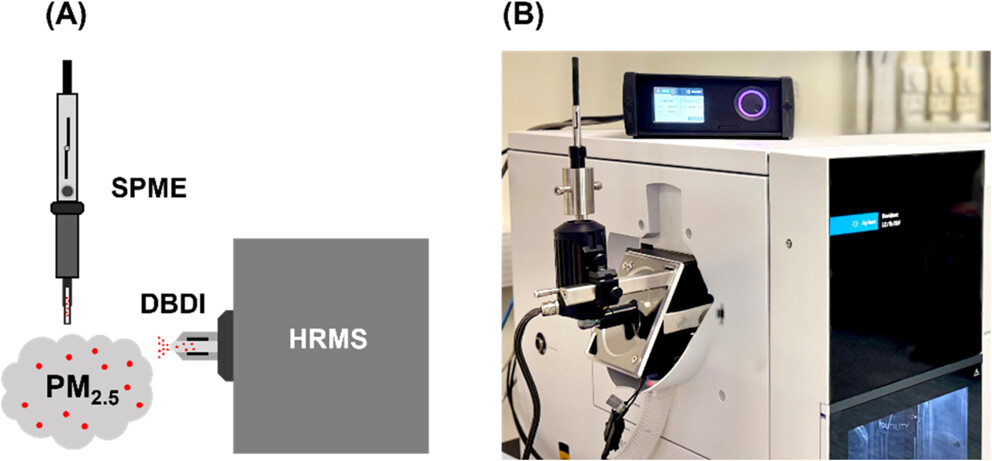
(A) Schematic illustration and (B) photographic image of the instrument setup.[1]
All figures reproduced from:
Wanlin Guo, Yanhao Zhang, Yawei Wang, Lin Zhu, Zongwei Cai. Anal. Chem. 2025, 97 (27). https://doi.org/10.1021/acs.analchem.5c03123
Licensed under CC BY 4.0 (https://creativecommons.org/licenses/by/4.0/)
Analysis
Results
Applied to atmospheric PM₂.₅ samples, chromatography-free SICRIT®-HRMS/MS enabled the simultaneous detection of ultrashort- and long-chain PFAS with high sensitivity. Detection limits ranged from 0.06 to 2.02 pg/m³, while in-source fragmentation was reduced by more than 60% compared to conventional LC-ESI approaches.
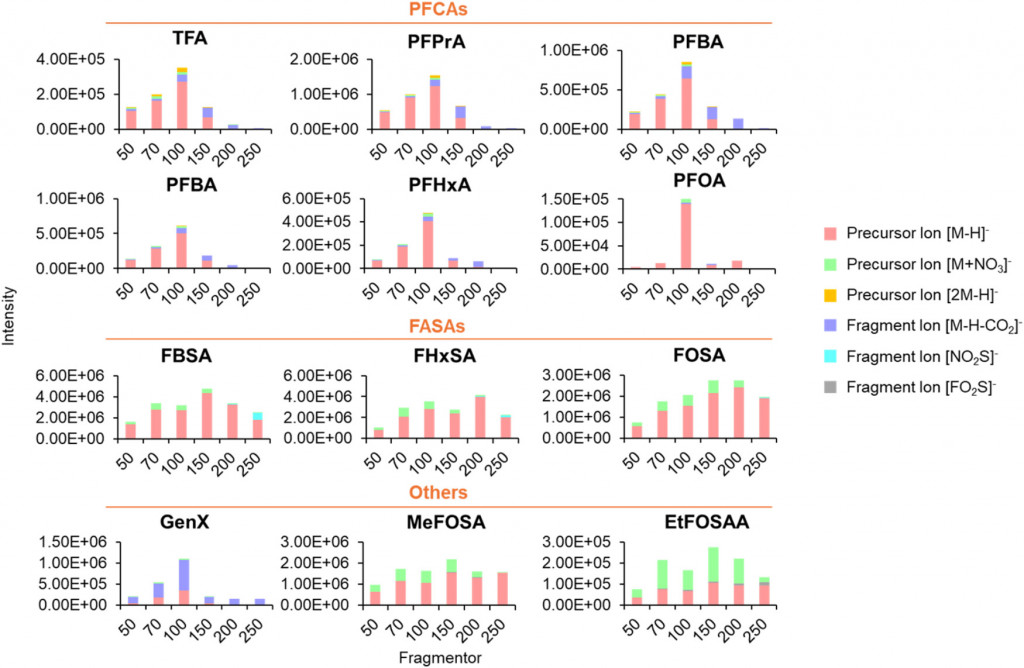
Ionization profiles of PFAS of different subclasses (PFCAs, FASAs, and others). Precursor and fragment ion distributions were derived from high-resolution mass spectra acquired in negative ion mode, with fragmentor voltages optimized between 50 and 250 V. [1]
Ultrashort-chain compounds such as trifluoroacetic acid were clearly identified through accurate mass measurement and diagnostic MS/MS spectra, demonstrating reliable structural confirmation without chromatographic separation. The method covered multiple PFAS subclasses within a single measurement, supporting comprehensive environmental profiling.
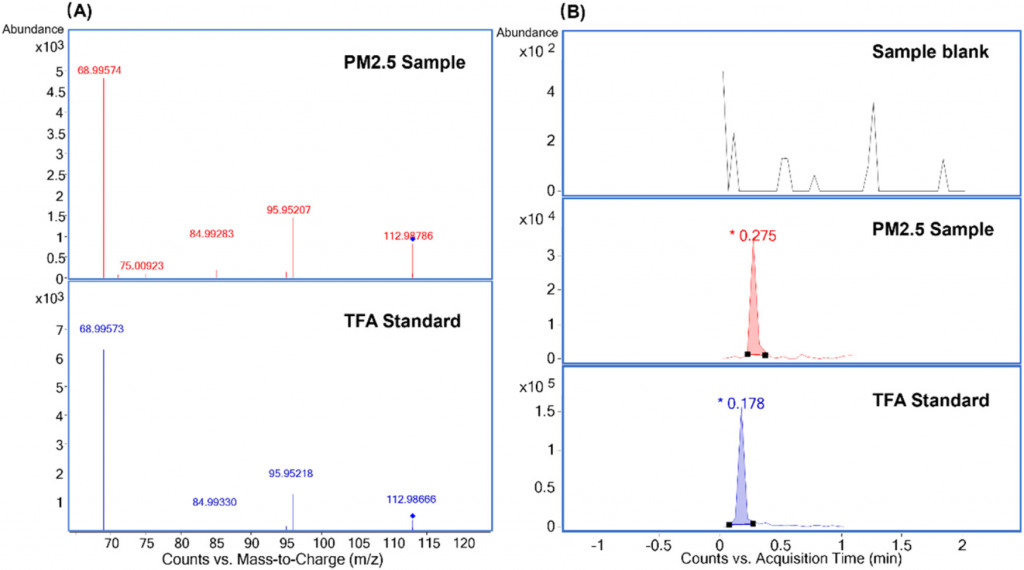
MS/MS spectrum of TFA detected in a PM2.5 sample and chemical standard spiked on blank sample (A) and EICs for TFA with the transition m/z 113 → 69 from a blank sample, a representative PM2.5 sample, and the chemical standard (B). Due to the manual injection approach, the retention time may vary among samples, whereas it will not influence the identification of targeted analytes. [1]
Practical
Value
Chromatography-free direct MS with SICRIT® enables research and analytical laboratories to expand PFAS coverage while simplifying workflows.
In practice, laboratories benefit from:
- Simultaneous detection of ultrashort- to long-chain PFAS
- High sensitivity in the pg/m³ range for environmental samples
- Reduced in-source fragmentation and clearer spectra
- Solvent-free SPME sampling with lower background contamination
- Elimination of chromatographic run time while retaining HRMS/MS confirmation
The result is a streamlined, confirmation-driven PFAS workflow that combines broad chemical space coverage with high analytical confidence.
Interested in applying chromatography-free SICRIT®-MS to your research?
[1]: Figures reproduced from:
Wanlin Guo, Yanhao Zhang, Yawei Wang, Lin Zhu, Zongwei Cai. Anal. Chem. 2025, 97 (27). https://doi.org/10.1021/acs.analchem.5c03123
Licensed under CC BY 4.0 (https://creativecommons.org/licenses/by/4.0/)