
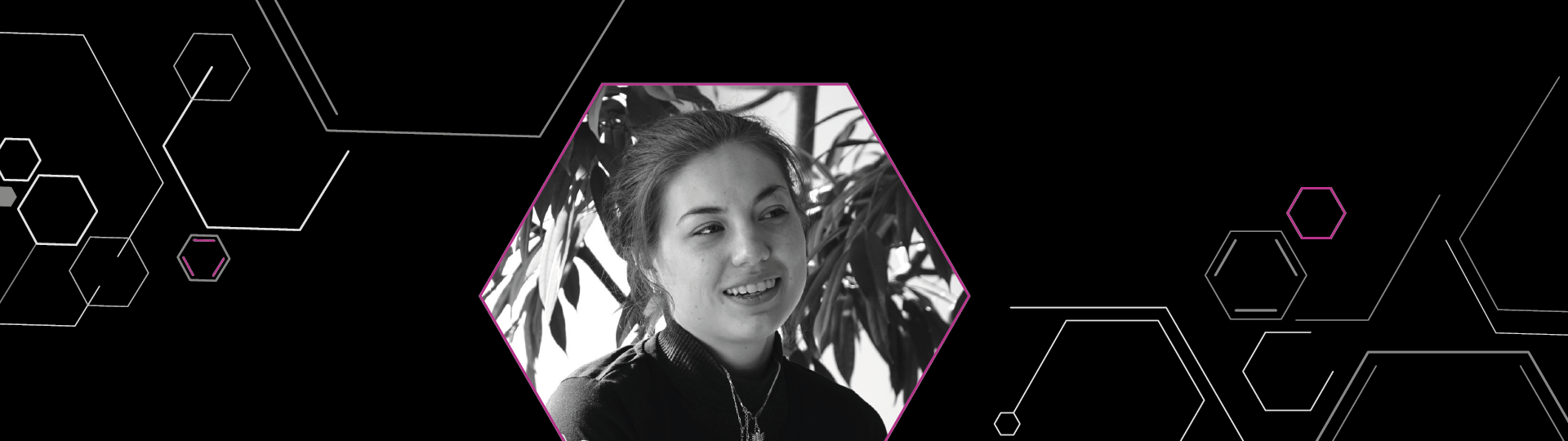
An interview with
Ciara Conway | Application Specialist
“Breakthrough innovation occurs when we bring down boundaries and encourage disciplines to learn from each other.”
– Gyan Nagpal
1) What is your role at Plasmion?
Originally, I was brought on as part of the sales team at the end of 2022, but quickly moved into Data Analytics and Lab Management. In these roles, I help contribute to our Research and Development in both lab and software applications.
2) What skills do you bring from your previous work that help you here?
With previous experience both as a synthetic chemist and bioinformatician, I help bridge the gap between the wet lab and computational lab to improve internal and external workflows through automation.
3) What is special about Plasmion as a company?
What makes Plasmion so special is the ability to explore and research new applications. We are given the freedom to be creative in our thought process and how we approach the solution to a problem. Additionally, we are extremely supportive of each other and the ideas or improvements people suggest, which makes the working environment far more enjoyable.
4) If you had unlimited resources, what groundbreaking idea would you work on?
If I had all the resources and time at my disposal, I would work solely on studying the interactions of outside toxins on the human body and how it can lead to debilitating outcomes. I would do this by providing people with free personalized medical testing and free third party testing of the products they use daily or have been exposed to. Here, we can bring together lab work and machine learning to give people the answers they need without draining them of time and money.
5) How often do you come across exciting discoveries that turn out not to be economically feasible?
All the time. My entire PhD is arguably a series of discoveries that are not economically feasible and often benefit the fundamentals of the field instead of the applicability. I personally think it’s that technology hasn’t caught up yet to make these fundamental discoveries economically feasible.
6) Which current technological development will most strongly change the way you conduct research in the coming years?
Any atmospheric pressure ionization technique. I think once I was exposed to a technology that could be adapted to almost all my ideas in the lab, there’s no way I could go back to doing research the way I used to. I never thought I’d willingly go back into the lab after doing a degree in bioinformatics, but this type of technology convinced me I can be a good lab scientist and a good coder and bring my skill set together in a cohesive manner.
7) What unusual or creative methods do you use to drive innovation?
I read science fiction/fantasy books and I knit compulsively. Most of my inspiration for innovation or ideas comes to me while I’m reading or when I’m sitting there mindlessly making a sweater. It’s just putting my brain in a state of calmness where something just pops in my head out of nowhere.
8) What has been the most exciting “aha” moment in your career – and what came out of it?
Realizing that starting over isn’t always a setback in the long run. Sometimes to achieve a particular goal we have to be willing to tear down and rebuild parts of our lives from the ground up. It’s this mindset that allowed me to leave the US and pursue a career in Germany. So I would say I’m in a pretty good place now.