
Analyzing What You Can’t Dissolve: Jet Desorption for Solid-Phase Direct MS
Solid samples don’t have to be dissolved to be analyzed. Jet desorption enables direct mass spectrometry on tablets, surfaces, and TLC plates – with results in under two minutes and no sample preparation. This article shows how the method identifies a pharmaceutical active ingredient straight off an intact tablet, by exact mass alone.
The Problem
The default workflow for solid sample analysis was originally built for liquid analysis, which required additional steps, leading to the following: dissolve, extract, filter, inject. For a lot of routine questions, this can be a very complex procedure to answer a few simple questions – and for some samples, it actively works against you. A pharmaceutical tablet isn’t a solution and turning it into one adds steps whose only purpose is to make the sample compatible with the instrument, not to answer the question. Product and material surfaces are often the actual object of interest – dissolving them destroys the very thing you wanted to characterize. The usual fallback, pyrolysis, overcomes solubility issues but trades it for thermal degradation and a loss of the original molecular information.
This shows up constantly in practice: pharmaceutical QC, where you want to confirm what’s actually in a dosage form; surface and material analysis, where the surface is the sample; and any solid matrix where sample prep is disproportionate to a simple identification question. The underlying question is the same one this series keeps returning to: what if the solid could just be measured directly, as it is – without dissolving it first? That’s the core idea behind direct mass spectrometry. In practice, that means mass spectrometry without sample preparation: no dissolving, no extracting, no filtering – just measuring the solid as it is.
How Jet Desorption Works
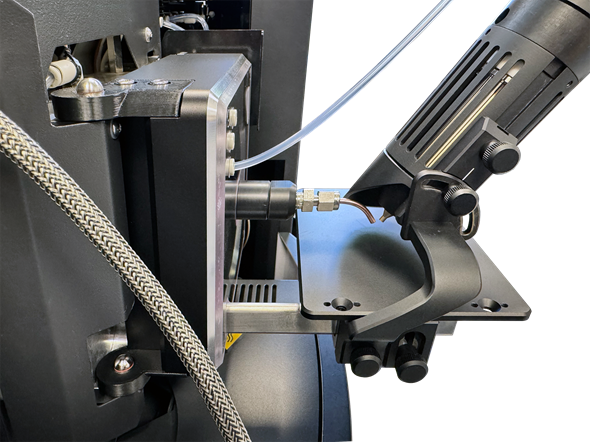
The principle is straightforward: a temperature-controlled hot air or nitrogen jet (30–500 °C) volatilizes compounds directly off a sample’s surface and carries them, contact-free, into the SICRIT® ion source – an ambient ionization mass spectrometry technique that requires no chromatographic separation. The module mounts at an adjustable angle – from 0° (concentric with the source inlet) to 90° (perpendicular) – which is what makes it practical for samples of varying sizes and shapes, from a glass slide to a whole piece of fruit, without redesigning the setup each time. The jet itself stays tightly focused, with a diameter under 3 mm measured 1 cm from the outlet, so desorption can target a defined spot rather than smearing across a whole surface.
The key practical advantage is that nothing touches the sample or the ion source. This matters more than one might initially think: concentrated, low-volatility, or otherwise „messy“ samples – pharmaceutical tablets, sugar-rich confections, and similar matrices – tend to contaminate or leave carryover in contact-based or enclosed direct-analysis techniques. An open-air, non-contact jet sidesteps that problem entirely, enabling solvent-free sample analysis regardless of matrix complexity.
Concrete Application: Identifying an Active Ingredient Directly From a Tablet
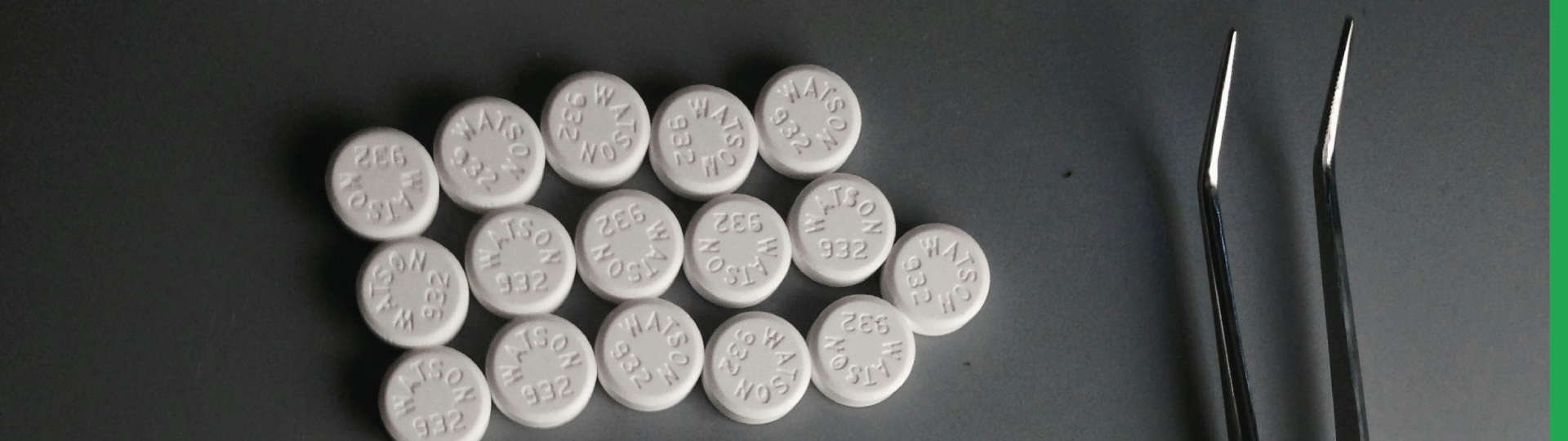
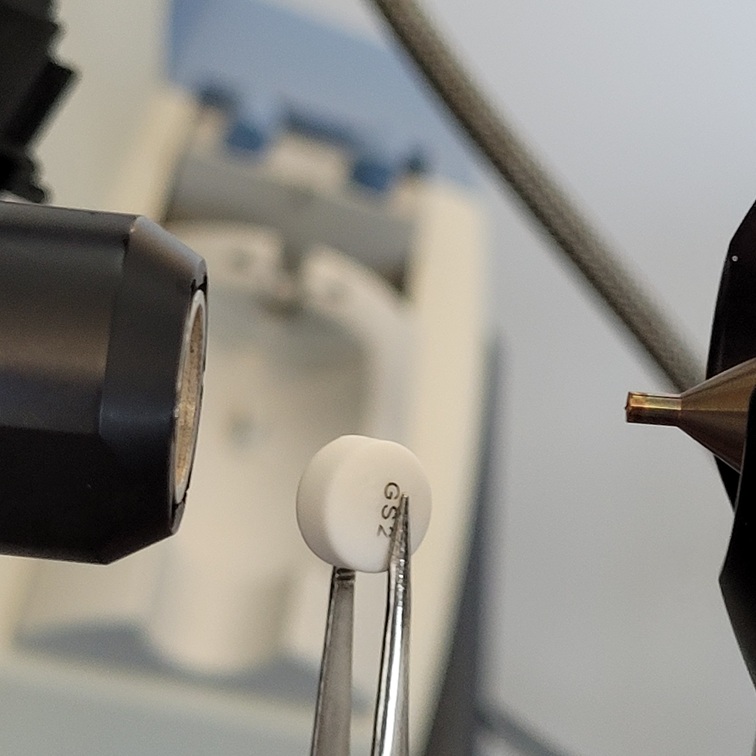
A representative case for direct MS analysis in pharmaceutical QC: confirming the active ingredient in an unknown pharmaceutical tablet, without dissolving it first. It’s a direct answer to a common lab question – how do you identify a tablet’s active ingredient by mass spectrometry without extracting it first? The tablet was placed in front of the jet, the desorbed compounds were carried directly into the SICRIT® source, and identification was made by exact mass identification and isotope pattern – no extraction, no solvent, no separation step.
The active ingredient was confirmed as bupropion (C₁₃H₁₈ClNO), detected as [M+H]⁺ at m/z 240.1150. That’s an exact-mass match, not a suggestive peak that still needs follow-up confirmation – the kind of result you could put directly into a QC record.
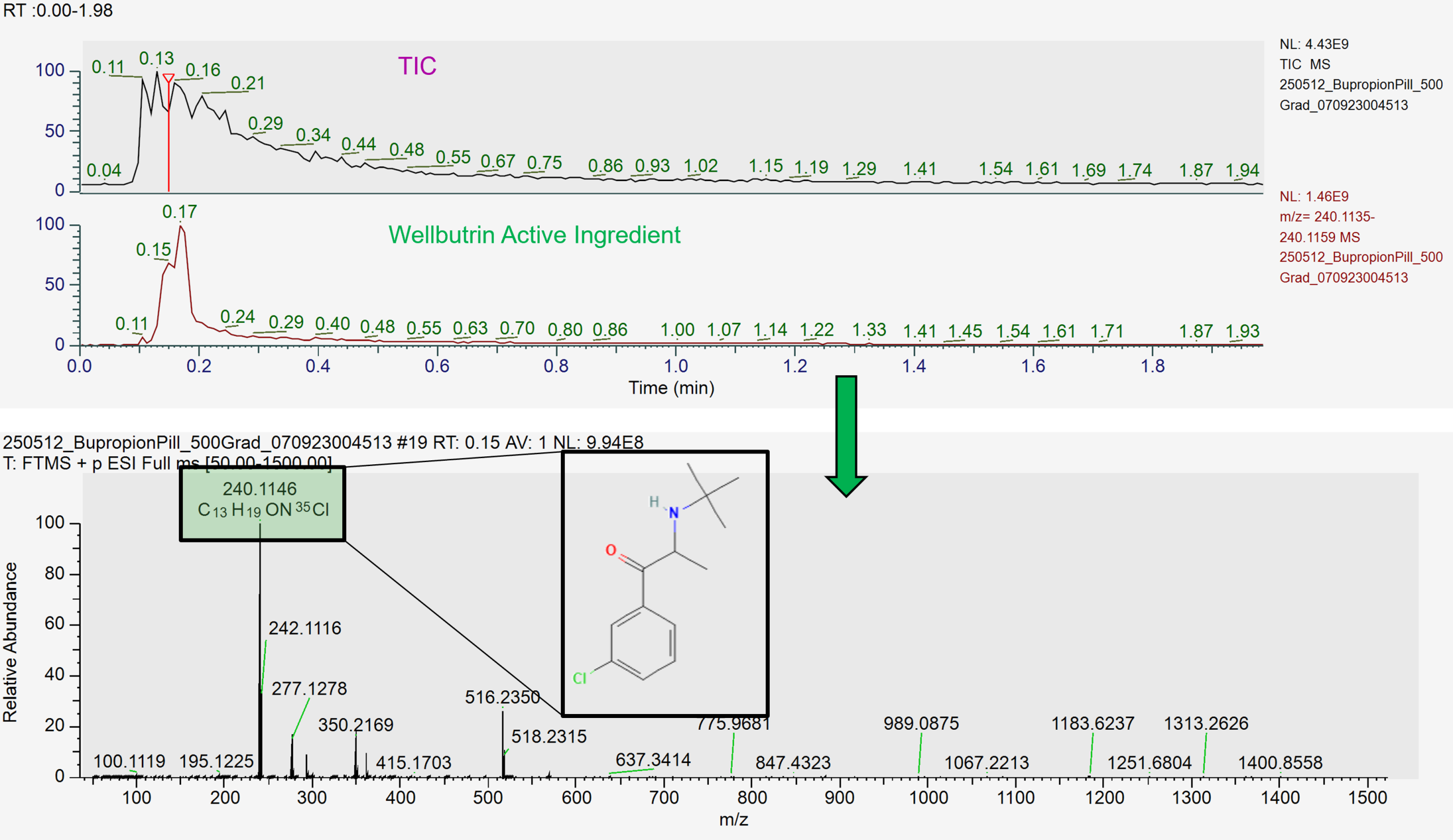
Direct identification of bupropion from an intact tablet: total ion chromatogram (top) and mass spectrum (bottom) showing the confirmed active ingredient at m/z 240.1150 ([M+H]⁺), based on exact mass and isotope pattern.
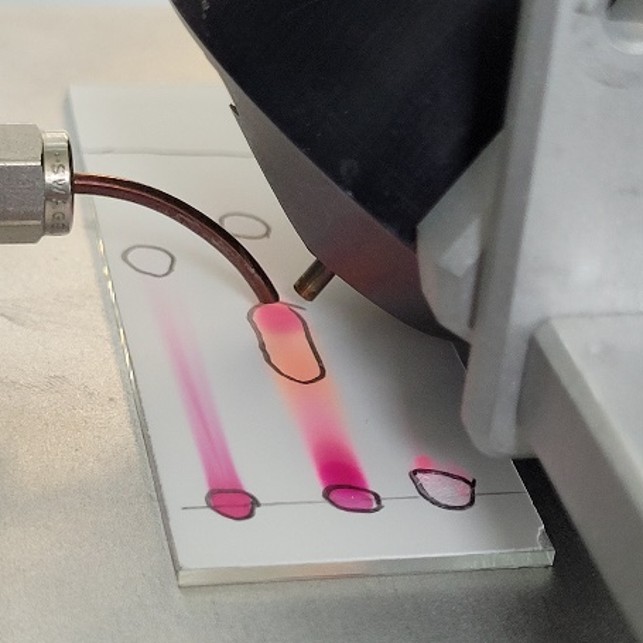
For a lab, the practical implication is the collapse of a normally multi-step workflow into a single, sub-two-minute measurement: no tablet dissolution, no extraction solvent, no chromatographic run, and still an identification with exact-mass confidence behind it. The same contact-free principle scales down to trace levels on flat surfaces, too – in a separate test, three deuterated drugs of abuse spiked at 1 ng each onto glass slides were each identified by exact mass in under a minute, and the same setup has also been used for TLC plate mass spectrometry readout, reading compounds directly off the plate independent of whether they’re UV-active or stainable.
Integration Into Existing Workflows
Jet Desorption isn’t a replacement for LC-MS or GC-MS in a lab that already runs those methods – it’s a front-end screening step for direct mass spectrometry. Its natural place is rapid pre-screening: confirming whether the expected compound is present at all before committing instrument time to a full quantitative, validated method. For pharmaceutical QC, mass spectrometry without extraction means the tablet itself becomes the sample – no prep step in between. It fits into off-line, at-the-bench sampling with standard sample formats – tablets, slides, TLC plates, or surfaces go in front of the jet as they are, and a dedicated sample table keeps smaller items like slides or TLC plates at a consistent, repeatable distance from the jet.
Curious how Jet Desorption would perform on your own samples? Get in touch – we’re happy to walk you through the technical details.
This post was created with the assistance of AI and editorially reviewed.