

Sensitivity vs. Selectivity: Reaching Regulatory LODs Without Overcomplicating the Workflow
Modern pesticide analysis forces a fundamental choice in mass spectrometry: prioritize sensitivity, or prioritize selectivity. In practice, both are non-negotiable. Methods must detect residues at sub-ppb to low-ppb concentrations, comply with regulatory thresholds, and perform reliably in complex matrices. All while keeping workflows manageable and data review efficient.
The sensitivity vs. selectivity tradeoff in mass spectrometry is well known. More signal is only useful if that signal can be distinguished from background with enough confidence to act on. In routine pesticide testing, it is often selectivity that fails first, not sensitivity.
The regulatory target is well-defined
For most pesticide residue applications, the relevant benchmark is the EU default Maximum Residue Limit of 0.01 mg/kg – equivalent to 10 ppb. This defines the practical sensitivity floor for routine compliance testing.
Reaching 10 ppb is achievable with modern instrumentation. The harder part is reaching it selectively with low false positive rates, minimal manual review, and the ability to distinguish real analyte signals from matrix-derived background.
Why sensitivity without selectivity creates problems
In conventional GC-EI-MS workflows, electron ionization distributes signal across many fragment ions. When analyte signals are weak or overlapping, diagnostic fragments can overlap with background peaks, and multiple ions must be evaluated together to support identification. As compound lists grow, this review burden scales accordingly, creating workflows where sensitivity is technically sufficient, but interpretation confidence is not.
A different signal architecture with GC-SICRIT®
GC-SICRIT® applies soft ionization downstream of the GC separation, promoting the formation of molecular and quasi-molecular ions – predominantly [M+H]⁺ or [M]⁺ – while substantially reducing fragmentation.
Instead of spreading ion current across 10–20 fragment peaks, the majority of the signal concentrates into one or two informative species. The result is cleaner extracted ion chromatograms, less signal overlap, and more straightforward peak confirmation, starting from the intact mass, extending to MS/MS only when needed.
Quantitative performance across 74 pesticides
In a quantitative study using GC-SICRIT® coupled to a Shimadzu LCMS-9030 QTOF, 74 pesticides were evaluated across a five-point calibration range (1 ppb to 1 ppm), with LODs calculated using the EU Commission spiked-blank equation.
The results were generated entirely in full-scan MS¹: no SIM, no MRM, no targeted optimization. Despite this, 70 out of 74 compounds achieved LODs at or below 10 ppb, with several reaching well into the ppt range. Achieving regulatory-relevant LODs in untargeted mode means the method retains broad screening capability without sacrificing detection performance. And if a targeted approach were applied, sensitivity could be expected to improve by a further factor of 3–10x.

LODs of a GC-SICRIT®-Q-TOF analysis of Restek, pesticide standards #1, #5 and #8 (left) calculated according to EU guidelines. Comparison of LC and GC cycles for three exemplary LC pesticides, measured using LC-SICRIT®-Q-TOF (top) and GC-SICRIT®-Q-TOF (bottom) (right).
What the four outliers reveal
Four compounds exceeded 10 ppb: Flutriafol, Fluridone, Vinclozolin, and Flusilazole. Their behavior is analytically informative rather than a method failure.
Structural analysis points to two explanations. Several of these compounds favor deprotonation over protonation, making negative ionization mode the more appropriate choice. For Flutriafol in particular, loss of water appears thermodynamically more favorable than [M+H]⁺ formation, diverting signal away from the target ion. These are known challenges in soft ionization broadly – the same compounds tend to be problematic in LC-ESI methods.
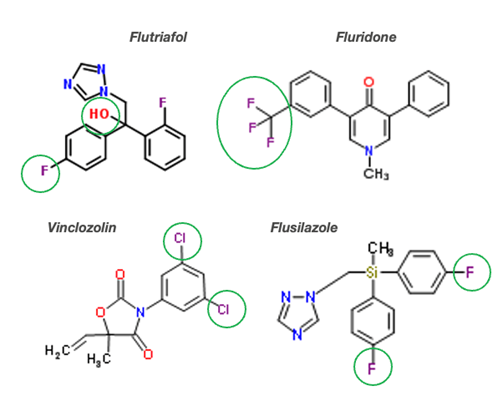
Structural information for each outlier, categorized by their respective standards. Areas of interest that help explain the higher LODs are highlighted in red.
A note on compounds difficult for LC-MS
One compound worth highlighting separately is Folpet. Under humid ionization conditions, comparable to what ESI experiences, Folpet failed to ionize entirely. Under dry GC-SICRIT® conditions, however, it produced a reliable signal with an LOD of approximately 5 ppb, well within the EU MRL of 30–70 ppb depending on matrix. This result is noteworthy for a compound that LC-MS often cannot detect at all.
Screening and confirmation in a single acquisition
Full-scan MS¹ with accurate-mass molecular ions provides the screening layer. Data-dependent MS² can then be triggered for compounds of interest, generating fragmentation spectra from a well-defined precursor. Critically, because the ions produced by GC-SICRIT® resemble those generated by LC-ESI, MS² spectra can be matched against existing LC-MS/MS libraries, opening access to a substantially larger reference database than conventional GC-EI libraries cover.
Conclusion
Sensitivity and selectivity are not independent variables. A method that reaches 5 ppb but requires extensive manual review may offer less practical value than one that reaches 8 ppb with clean, directly interpretable data.
GC-SICRIT® approaches this tradeoff by concentrating signal into molecular ions. The result, across 74 pesticides in full-scan acquisition, is regulatory-relevant LODs for the large majority of compounds, combined with spectral clarity that simplifies interpretation and keeps the workflow scalable.
Read also:
Published by Analytik News: Zwei Geräte, eine Sprache: Wie eine neue Ionenquelle GC- und LC-Pestizidanalytik zusammenführt
Published by Separation Science: DBDI: A Bridge Between GC and LC-MS
Published by Wiley Analytical Science: Weiche Ionisierung vereint Pestizidanalytik auf GC und LC
Published by LABORPRAXIS: Pestizidanalytik ohne Kompromisse: 687 Pestizide in 15 Minuten
Published by Labmate: Pesticide analysis without compromise: How DBDI ionisation bridges GC and LC-MS
This post was created with the assistance of AI and editorially reviewed.