

Can GC Compete with LC-MS/MS in Pesticide Confirmation?
For most regulatory laboratories, the answer has been: not in the same way. LC-MS/MS has become the dominant platform where MS/MS-based confirmation is required, built on two decades of method development, validated workflows, and mature spectral libraries. GC-MS, with its established fragment-based identification criteria, like retention times, accurate masses, and ion ratios, remains a fully valid confirmation approach for GC-amenable compounds. What it cannot provide is a direct route into MS/MS workflows, because extensive EI fragmentation typically leaves no intact molecular ion to serve as a precursor. That specific limitation is worth addressing directly.
The confirmation gap
Confirmation in pesticide analysis means demonstrating that a signal corresponds to a target compound with sufficient structural evidence. For GC-EI, this is well-established: defined retention times, accurate masses, and reproducible ion ratios across multiple diagnostic fragments provide a robust and widely accepted basis for identification. For many laboratories and many compounds, this is sufficient.
Where MS/MS-based confirmation is additionally desired, for example to further differentiate structurally similar compounds or to access LC-MS/MS spectral libraries, GC-EI runs into a specific limitation: no suitable precursor ion is available for CID-based MS² experiments.
What changes with soft ionization in GC
GC-SICRIT®-MS shifts this picture by generating LC-like ions from GC-separated compounds. The SICRIT® ion source serves as a connector between GC separation and LC-MS detection. Instead of fragmenting analytes with high-energy electrons, the ionization mechanism promotes molecular and quasi-molecular ions – [M+H]⁺, [M]⁺, and in some conditions [M+NH₄]⁺ – with minimal fragmentation.
The practical consequence is that the molecular ion, now dominant in the spectrum, becomes a well-defined MS/MS precursor. Data-dependent acquisition can trigger CID fragmentation on this precursor, generating MS² spectra that closely resemble those produced by LC-ESI methods; the same ion chemistry, applied to compounds separated by gas chromatography rather than liquid chromatography.
Coverage across the pesticide chemical space
Research from Ciara Conway (Technical University of Munich), using a GC-SICRIT®-QTOF pipeline, demonstrates the scope of what this approach covers.
Across 412 pesticides analyzed in both positive and negative ion mode, 403 were successfully observed – a detection rate of 98%. 100% of GC-amenable pesticides were detected, with LODs ranging from low ppb to high ppt. More significantly, 96% of LC-amenable pesticides were also observed, without any derivatization, and all in positive ion mode. This challenges the traditional partition of pesticide analysis into GC compounds and LC compounds. With soft ionization, that boundary becomes considerably less rigid.
In a single analytical run across 687 pesticides, spanning both GC-amenable and LC-amenable compound classes, 99% were successfully observed in a 15-minute runtime using hydrogen as carrier gas, with a linear dynamic range exceeding three orders of magnitude and sensitivity meeting EU MRL thresholds throughout.
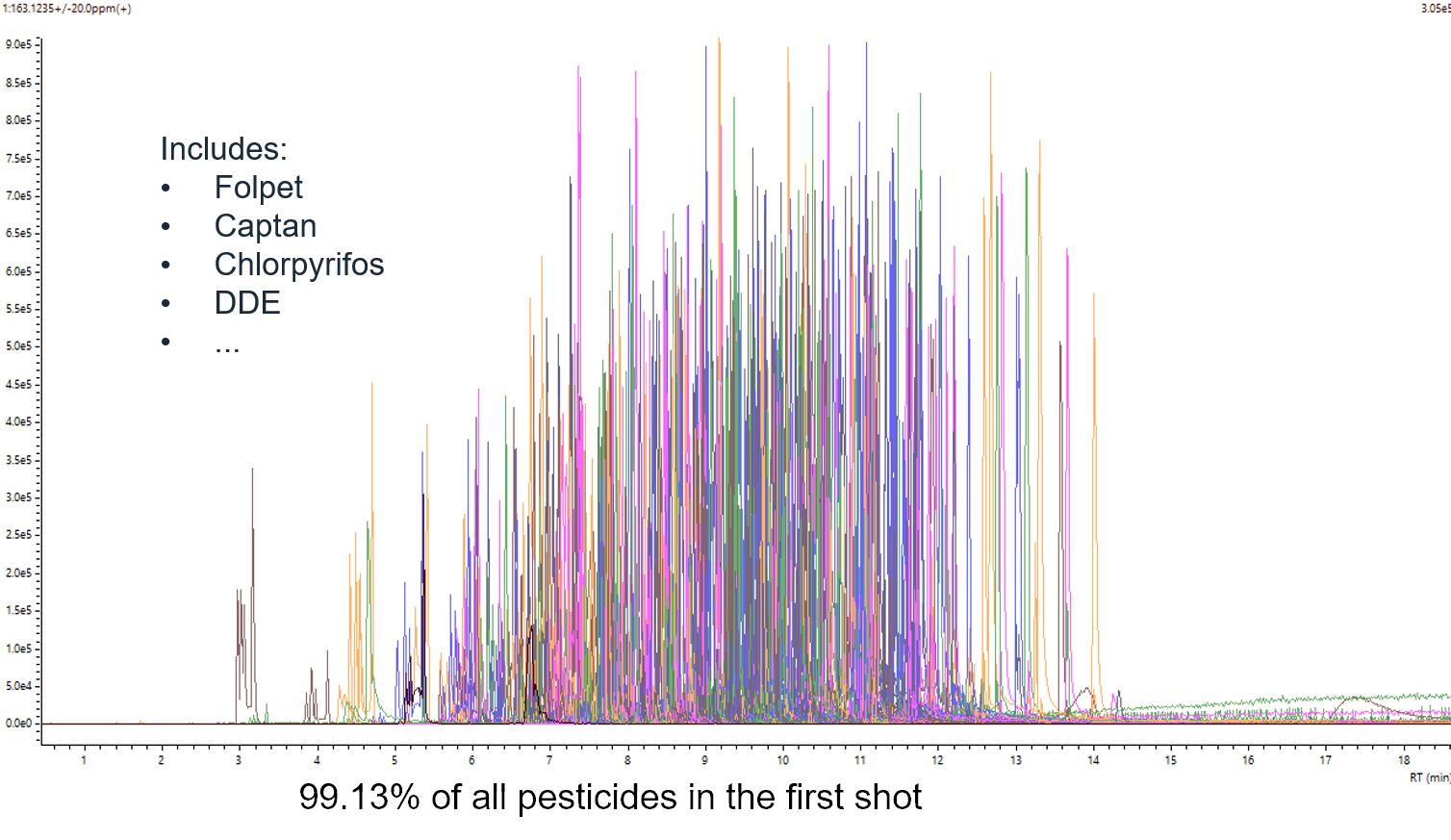
GC-SICRIT® MS for simultaneous analysis of 687 LC- and GC-amenable pesticides in a single matrix, within a 15-minute runtime. LODs meet EU regulatory thresholds: <10 ppb
Library matching: accessing LC-MS/MS databases from a GC system
Because GC-SICRIT® generates [M+H]⁺ precursors chemically equivalent to those produced by ESI, the resulting MS² spectra can be matched directly against existing LC-MS/MS libraries. The following examples illustrate how this works in practice.
For Diazinon, the GC-SICRIT® MS² spectrum matched the Shimadzu LC-MS/MS library entry as the top hit, correctly identifying the compound through the library search. For Fenthion, library matches of 92% and 98% were achieved from two different ion species in the same acquisition. These results point to an interesting behavior: SICRIT® appears to simultaneously generate odd-electron [M]⁺ and even-electron [M+H]⁺ species, potentially enabling independent MS² spectra and independent library searches – [MH]⁺ matched against LC-MS/MS databases, [M]⁺ against GC-MS databases – from a single run. Where both match independently, confirmation confidence would be substantially higher than any single-ion approach can offer. This dual-ion behavior is based on initial observations and is currently under further investigation.
![GC-SICRIT® MS² spectrum for Fenthion [MH]⁺ (top) and [M]⁺ (bottom) overlaid with LC-MS/MS library reference spectra, showing 92% and 98% match scores](https://plasmion.com/wp-content/uploads/2026/06/Figure03_FenthionMHandM-1024x430.png "Figure03 FenthionMH+andM+")
GC-SICRIT® MS² spectrum for Fenthion [MH]⁺ (top) and [M]⁺ (bottom) overlaid with LC-MS/MS library reference spectra, showing 92% and 98% match scores
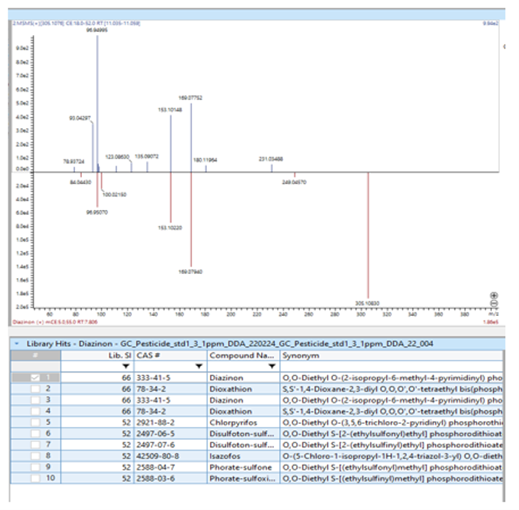
GC-SICRIT® MS² spectrum for Diazinon overlaid with the Shimadzu LC-MS/MS library entry, annotated with the top library match
A necessary nuance: when GC-EI libraries still apply
Not every compound follows the clean molecular-ion route. For some pesticides, e.g. DDE is a documented example, CID fragmentation of the SICRIT® precursor produces spectra that more closely resemble a GC-EI MS¹ pattern than an LC-ESI MS² pattern. In these cases, GC-EI spectral libraries remain the more appropriate reference.
This reflects the underlying ionization chemistry and the structural properties of specific compound classes, not a failure of the approach. Knowing which compounds fall into which category is part of building a robust confirmation workflow, and it reinforces the case for maintaining both library types as complementary resources.
One mass spectrometer, two chromatography systems
SICRIT® changes the infrastructure picture directly. The same ionization technology can connect either a GC or an LC through dedicated coupling modules to the same MS system. GC and LC measurements continue to run as separate acquisitions, but share the same ion chemistry, the same spectral library, and the same confirmation workflow.
There will always be applications that specifically require EI fragmentation patterns or ESI for polar and ionic compounds. What SICRIT® makes possible for the first time is a third category: applications where a single ionization approach covers both GC- and LC-amenable compounds on one unified MS platform. For laboratories identifying which of their methods fall into this category, the practical implication is fewer instrument ecosystems, less duplicated method development, and a simpler analytical framework overall.
Conclusion
GC-SICRIT® does not replace LC-MS/MS in pesticide confirmation. The two platforms retain distinct strengths, and for many applications, both will remain part of a complete analytical strategy.
What has changed is the MS/MS confirmation capability of GC-based workflows. Soft ionization produces the intact precursor ions that CID-based MS² experiments require; a route that conventional GC-EI, by design, does not offer. Library matching against LC-MS/MS databases is feasible and, for the majority of compounds, effective. And the analytical space covered is broader than any single soft-ionization platform has previously accessed from a GC separation.
The question is no longer whether GC can compete with LC-MS/MS in confirmation. The more useful question is how the two approaches can be designed to complement each other.
This article is part of a three-part series on GC-SICRIT® in pesticide analysis.
Read part one: The Molecular Ion Problem in GC-MS Pesticide Analysis and part two: Sensitivity vs. Selectivity: Reaching Regulatory LODs Without Overcomplicating the Workflow.
Read also:
Published by Analytik News: Zwei Geräte, eine Sprache: Wie eine neue Ionenquelle GC- und LC-Pestizidanalytik zusammenführt
Published by Separation Science: DBDI: A Bridge Between GC and LC-MS
Published by Wiley Analytical Science: Weiche Ionisierung vereint Pestizidanalytik auf GC und LC
Published by LABORPRAXIS: Pestizidanalytik ohne Kompromisse: 687 Pestizide in 15 Minuten
Published by Labmate: Pesticide analysis without compromise: How DBDI ionisation bridges GC and LC-MS
Image by aleksandarlittlewolf on Magnific
This post was created with the assistance of AI and editorially reviewed.